Comparing the American Revolution and the French Revolution
The causes of both revolutions were similar in that they dealt with economic hardships and desire for political influence. The main difference between the two revolutions was that the result of the American Revolution was a successful, independent republic, while the result of the French Revolution was a republic that did not solve any problems and made things worse.
Both revolutions were caused by economic crisis. After the Seven Years War, Britain was in post-war debt and levied the Stamp Act, Sugar and Molasses Act, and Tea Act on the colonies, which sparked colonial protest and boycotts and and bred dissatisfaction. The Seven Years War also caused economic debt in France. Financial aid to the American Revolution worsened the debt. When the Estates General and the monarch could not create a successful tax levy and bread prices continued to soar, the peasants and urban workers attacked the Bastille.
Another similarity was that both American and French revolutionaries wanted to improve their political status and have a more constitutional government. American colonists wanted political freedom to elected their own government instead of having a monarch rule across the Atlantic Ocean. The French third estate was unsatisfied with their little political influence despite having wealthy and intellectual members. They organized the National Assembly to protect the interests of the third estate, which was the majority of the people, against King Louis XVI. The reason why the ideas of reforming the monarchy was common among both Americans and French was because the Enlightenment brought up ways to improve the government.
Both revolutions led to ill-treatment of loyalists or monarchy supporters. When the American rebels won, they were supposed to return Loyalist land under the Treaty of Paris, but in reality, the Loyalists were so badly treated by the victorious rebels that most of them were exiled to Canada. Many members of the royalists and moderate (Girondist) groups of French society fled France or were killed by the guillotine when the Revolution entered the Reign of terror phase.
One difference was the outcome of the American Revolution created a lasting republic, while the French Revolution created a meager republic followed by a dictatorship. After the colonists won, state and federal governments were set up that had a balance of power between the executive and legislative branches. Although changes in the system occurred, the governments remained a republic. After Louis XVI was killed, the French Republic was created, but it was far from being a republic since Jacobins randomly killed anyone who they suspected as enemy of the Republic. This Republic did not solve any of the economic crisis, nor did the following Directory, which led to Napoleon establishing a military dictatorial empire.
Another difference was that the American Revolution was more organized and war-like than the radical, bloody French Revolution. The American colonists organized the Continental Army and fought with Britain until the Treaty of Paris was reached. The French Revolution began with bloody riots and eventually the Reign of Terror, which was the execution of thousands of innocent people.
The American Revolution drew supporters from other countries, while the French Revolution only made other European nations afraid and against France. Native Americans aided both the colonial and British side, and France allied with America. When the colonists won, Europeans were fascinated with and inspired by the new country. On the other hand, European countries such as Austria and Prussia threatened to stop the revolutionaries and help the French monarch when the Revolution began to get radical. The reason why other countries helped the American Revolution but not the French was that the Americans fought for the glorified idea of independence and democracy, and their methods were stately. European states were appalled at the aimless mass killing of people by the Jacobins and allied against France in case its radical methods spread to their countries.
Friday, January 30, 2015

Friday, January 16, 2015
Art in the Ottoman and Mughal Empires
Ottoman Empire Art
Ottoman art was influenced by Seljuk, Byzantine, Persian, and Mamluk cultures. Mosques had vast inner spaces surmounted by massive domes, corner minarets, columns, and a constrast between light and shadow. Kulliyes, a complex of buildings centered around a mosque, was another characteristic. Ottoman architecture remained uniform over time. The Hagia Sophia church and the Selimiye Mosque in Edirne are some of the most important models for Ottoman mosques. Miniature paintings, influenced by Persian, Byzantine, and Chinese art, were often in shades of bright red, green, and blue. A key feature in Ottoman art was the use of abstract topics as opposed to human figures. Carpet weaving, jewelry making, paper marbling, Iznik ware ceramics were also created in the Ottoman Empire. Carpets, often made of silk and cotton, were used on both floors and wall/ door hangings. Hereke silk carpets were the most valued of all Ottoman carpets.

Mughal Empire Art
Mughal art styles borrowed from the Renaissance and Persian/ Indian sources. Massive and lavish monuments and palaces were built by Muslim emperors such as Humayun's Tomb. During the golden age of Mughal art, many splendid monuments such as the Pearl Mosque, the Red Fort, and Taj Mahal were erected. The famous Taj Mahal, known for its symmetry, had large, white marble stands with an arch shaped doorway topped by a large dome and finial. Mughal paintings borrowed individual and naturalistic motifs of the Renaissance and Mannerist styles, but also Indian and Persian traditions. Miniature paintings that depicted scenes of court life, wildlife, hunting, and battles were common in classic works of Persian and Indian texts.

Friday, January 9, 2015
HBD to the Magna Carta
Back in thirteenth century England, there was rising tension between the dictator-like King John and the barons. First of all, John expelled monks in Canterbury, so the pope excommunicated. On top of that, barons were talking bad of him via Shakespeare since they were being suppressed; they could not celebrate mass, so many fled to neighboring countries. These countries conspired against England. Thus, King John was forced to surrender to the barons and the pope and signed the Magna Carta. During that time period, the Magna Carta was nothing special. In fact, it was a failure since no king in his right mind conformed to its terms of giving the barons right to seize all the king's possession if he broke any of the other laws. When John broke the Magna Carta's terms, French king Louis came to England under the support of the barons to take the throne. In the end, John died. His son Henry had a regent, William Marshal, who reissued the Charter to become the monarchy's most powerful weapon. Centuries later, the Magna Carta was once again revived by Edward Coke, a parliamentarian during the English Civil War.

1. OMG what was the king's hostage doing to her son??!!??!
SHE WAS EATING HIM OMG EW!
2. At the time, what was England's relationship with its neighbors? Not very good at all; France, Wales, Scotland, and Rome all conspired to overthrow the monarchy in England. Also, King John alienated the papacy.
3. Why did King John agree to the Magna Carta? He was faced with the threat of invasion by those countries in #2 because of all the baron's complaints and dissatisfaction.
4. What was the impact of the Magna Carta at the time? It was nothing new and pretty much a failure.
5. How did later kings use the charter to their advantage? When John died, his son's regent William Marshal defeated the rebels by reissuing the Charter that turned it from weakening king into monarchy's most powerful weapon.
6. How did Edward Coke revive the importance of the charter? He was a leader of the parliamentaries during the English Civil War and revived the charter by using it against King James I and as the basis of the Petition of Right.
7. How did American colonial leaders use the Magna Carta? The colonists were inspired by Coke and valued the Magna Carta in creating their government. So, they used the Magna Carta as inspiration of the right of freedom during the American Revolution against Britain.
8. Why is the Magna Carta more important to modern Americans
than to the British? The constitutional framework of America is taken from the core concepts of the Magna Carta and is embedded in the perception of justice and law of Americans.
Friday, December 12, 2014
Failed Colonies of America
Fort Caroline

- What insights do you gain from comparing the French and Spanish accounts of the 1565 attack? Spanish account that attack as glorious and ennobling. They focus on the general who had ordered the slaughter of French Lutherans as merciful and resilient. On the other hand, the French describe the brutishness of the Spanish through imagery of the slaughter: "...killing all whom they found, so that awful outcries and groans arose from those who were being slaughtered."
- How do they decide what is ethically and politically acceptable in their actions and in the actions of their enemies? The Spanish believe that the killing of Frenchmen was justified because they were Lutherans or "enemies of God." The French also accept their fate, blaming their own sins not the Spanish. The Spanish believe that taking the enemy's fort is good because they gain valuable cargo and allow them to spread the holy Gospel. The Spanish do not accept any Lutherans and only spare the French Catholics.

Fort Caroline and Ajacan
- What do the settlers see as the strengths and weaknesses of their colonies? A weakness of Ajacan was the scarcity of food, which lead to famine and death. However, the settlers of Ajacan benefited from the kindness of the Indians there, who gave them info about the land. The weakness of Fort Caroline for the French was the unpredictable weather; a hurricane destroyed many of their ships while they were going to attack the Spain.
- Which do they ascribe to external factors? to themselves? The French attribute external factor of the hurricane to their inability to attack the Spaniards first. They also blame themselves for being too trusting of the Spanish. The soil of Ajacan was poor and could not produce enough food for the settlers. The settlers also blame themselves for being unwise when dealing with the Indians. The settlers did not give the Indians anything in return, so their food was taken away.
- Evaluate the colonists' planning for the settlements. How do they adapt to unforeseen problems? The settlers decide to continue settling on the land the Indians gave to them and learned how to wisely barter with the Indians. The French abandon their colony and admit to defeat by the Spanish.
- How did colonists' relationships with the Indians affect their fate? At first, the colonists' benefited from the Indians, who gave them food and tips on where was the best to settle. However, the downfall of the bartering alliance comes from them not repaying the Indians.
- How did their perception of natural environment affect their fate? The settlers did not expect the environment of Ajaca to be so poor, and they had adversities until the Natives helped them.
- How did the leadership in each colony affect its fate? The leader of Ajaca was Father Segura, and he forbade the settlers from giving anything to the natives, which led to their loss of the Indian's help. The leader of French Fort Caroline was Ribaud. He was too naive and trusting toward the Spanish, and this caused him and almost all other of his followers to be killed.
- What is critical for a successful colony? Choosing the right region and which season to settle is crucial because this determines the amount of available resources. Having a prudent and diplomatic leader is also important.

Fort Caroline and Roanoke
- To what extent did the colonists prepare for failure? Upon knowing that their battle ships were destroyed, some of the French prepared for defeat and abandoned Fort Caroline to return to France, while other stayed behind only to meet failure. The colonists at Roanoke abandoned the site.
- How did the colonies end? Roanoke was abandoned without any sign of distress. Fort Caroline was seized by the Spanish from the French.
- How might these accounts differ from those of successful colonies? These accounts describe America environment to be very different from the unrealistic descriptions of America back in Europe. These accounts recall the struggles of the colonists, while successful stories only focused on the reward and outcome.

Fort Caroline, Ajacan, Roanoke
- What might have saved these colonies? A region with better resources and not near any rival colonies such the Spaniards.
- What might a prospective settler learn from these documents? A settler might learn the risks of colonization and learn to plan ahead extensively. One should bring lots of supplies in case of poor environment.
- How did European rivalries affect the fate of these colonies? The rivalries between the expansion zeal of Spain, England, and France cause each to kill off one another's colonies. The colonies were subject to attacks by another country's colonies.
Friday, December 5, 2014
BBC Summary
The Execution of Charles I
 The execution of King Charles I was actually not favored in the hearts of the English. Many people stated that they wanted to execute the king, but they were pressured by the influential Oliver Cromwell and regretted their actions. Regicide was quite shocking in the minds of Europeans. Two members of the Rump Parliament, Thomas Hoyle and Rowland Wilson, committed suicide out of guilt for killing the king. The Old Testament instilled the idea of regicide in people with stories of unrighteous kings being overthrown by God's people. Puritans believed in regicide because they believed that the Scriptures provided the blueprint for politics and the justice for people to overthrow their authorities. Thomas Dugard, a moderate parliamentarian, preached that Charles I's Book of Sports as sinful and cause of bloodshed because it allowed licensed recreations on Sabbath Sundays. Thus, people believed that Charles had provoked God's wrath.
Educated Englishmen saw Charles as Caligula, an ancient Roman tyrant since universities familiarized them with republican understanding of politics and corruption of government. They advocated monarchical republics such as the reign of Elizabeth I when the landowning men could participate in legal and political affairs. The experience of civil was cost many lives and money. Taxation broke records and troops that lacked pay plundered helpless commoners. The result of the war was people demanding rewards for all their sacrifices. Additionally, the idea that God was punishing the king was strengthened when Charles lost the war.
The Parliamentary army changed politics in England in the Declarations of Parliament, which defended people's just rights and liberties while stating the duty to overthrow Charles for his perfidy. Trial of the king for crimes against his people and laws of England had real basis, and it was decided that Charles should be executed in the face of the world. After Charles's execution, the people developed a radical view of government. The purged Parliament wanted to abolish monarchy altogether and govern by its own representatives or national meetings in council.
Friday, November 21, 2014
Medieval, Gothic, and Renaissance Art
Medieval Art


 There were eight artistic movements: Byzantine, Islamic, Viking, Carolingian, Celtic, Ottonian, Romanesque, and Gothic art. Medieval art represents the popularity of Christianity. Since the Bible prohibited graven images, artists avoided sculptures that could be viewed from all around and tended toward one dimensional art. Islamic art was known for tessellated patterns, depiction of heaven as a flowering place, geometric forms, and calligraphy. The vikings excelled in wood and metal work , and golden brooches were common. During the Carolingian period, many extravagant churches with luxuries were created. Contrary to Byzantine art, Carolingian art used human forms. Illuminated manuscripts of religious texts were common for artists to embellish in. Celtic art was influenced by geometry and animal depictions. Ottonian art took on a Germanic style. Romanesque architecture gained popularity by 1000 AD. Frescos and reliefs were common on church walls. Inspired by painter Giotto, Gothic art was more realistic than its predecessors. Key change in architecture was incorporation of sculptures as architectural elements.
Gothic Art
 From France, Gothic art made cathedrals and stained glass windows larger than ever before. It strayed from imitations of classical Roman art. Gothic style was influenced by Romanesque style; however, Gothic cathedrals were very high unlike the short and wide ones in Romanesque. Distinctive traits of Gothic art were the ribbed vault, flying buttress, and pointed arch. Architectures competed to build cathedrals taller and taller. The French cathedral of Saint Denis is the best known model of Gothic cathedrals. It served as burial place for kings. The naturalistic style remained dominant. Stained glass window in Gothic design was known as the rose window. Illuminated manuscripts were highly decorated with intricate borders, and the most famous artists of these were the Limbourg brothers, known for painting Jean de France's Book of Hours. Christ was always symbolized as the lamb in these books. Calligraphy remained predominant in all Gothic art.
Renaissance Art
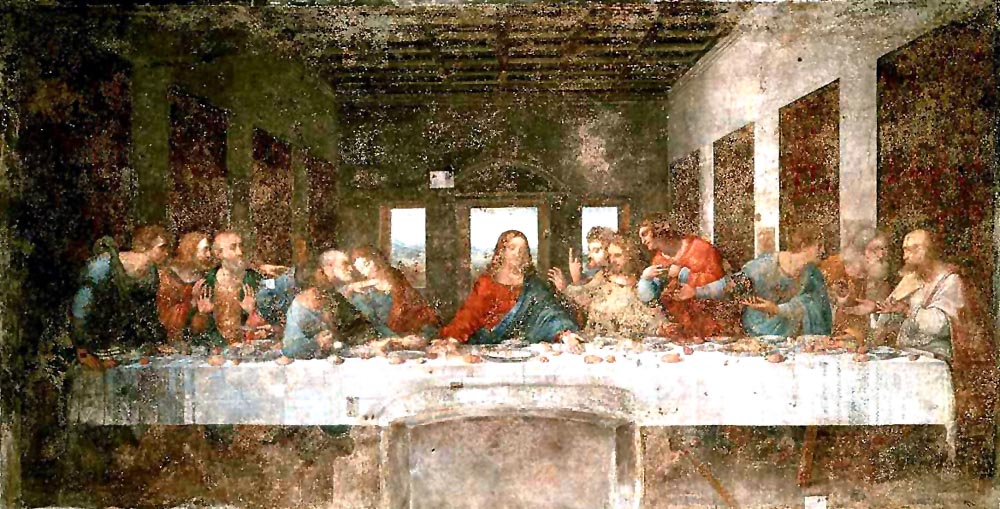
Devalued the dark medieval traditions in favor for renewal of ancient Greco-Roman culture. Michelangelo, Raphael, Leonardo Da Vinci were among the most famous Renaissance artists. A complete shift from medieval ideas, the Renaissance valued personal responsibility and knowledge. Major features of Renaissance art were realistic scenery, linear perspective, and chiaroscuro, contrast between light and dark paints. With the new concept of perspective, once flat images could be mathematically positioned and allow for more dimension and depth. Masaccio's Holy Trinity was the first to use perspective to accurately represent a space. The Church and the Medici family in Italy patronized artists to replace Byzantine mosaics with lively mythological and biblical sculptures and paintings. Masaccio, Donatello, da Vinci, and Michelangelo were patronized by the Medicis. One of the most famous paintings in the world is da Vinci's Last Supper. Michelangelo created the famous ceiling of the Sistine Chapel. A rival sculptor, Raphael, decorated the walls of the Vatican Library, featuring the School of Athens.


Friday, November 7, 2014
Pre-Colombian Mesoamerica Podcast Q&A
1. How does the speaker define the area that is "Mesoamerica"?
Mesoamerica is defined by the speaker as the Mexico and Central America region.
2. How did the topography of Mesoamerica impact civilizations?
 Mesoamerica was a high plateau with mountains and slopes to sea level areas. This was important because the different landscape produced different resources and facilitated trade.
3. What goods were produced in the highlands and lowlands?
The higher area in the center produce obsidian while the sloping lowlands produced seashells and feathers.
4. Why was is so difficult to move goods in Mesoamerica?
There were few navigable rivers and no domesticated animals to carry goods by land. Goods were slowly moved by men or canoes.
5. What accomplishments can we credit the Olmecs with?
The Olmecs carved huge stone heads and were the first to build ceremonial complexes for worship and pyramids. They invented the first ball game. They (not the Mayans) also invented the calendar and writing.
6. Describe the Olmec calendar system.
There were two calendars, one solar of 365 days and one lunar of 260 days. Every 52 years, the first days of each calendar coincided.
7. What was the purpose of Olmec pyramids?
Their pyramids were used for places of worship.
8. How were Mayan pyramids different than Olmec pyramids?
They looked different from Olmec pyramids because they were steep and very narrow.
 9. Why was Mayan history "lost" at the time of contact?
After their collapse in the classical era, the Mayans abandoned their cities, but still existed. When the Spanish arrived, much of the Mayan writing could not be deciphered even by the Mayans themselves. So, we'll never fully understand their history.
10. How does she say that the Aztecs were different than other mesoamericans?
The Aztecs were different because they were successful expansionists and aggressive tribute collectors. Though human sacrifice existed in all of the Mesoamerican civilizations, the Aztecs took that to an unprecedented scale.
11. What was the purpose of the tribute systems of the Aztecs?
Their land could not produce enough food to support the growing Aztec civilization, so tribute systems were put into effect to collect food and money-making resources.
12. Describe the Aztec creation myth.
The Aztecs believed in this myth that said the world was created and destroyed four times and recreated by the sun god for the fifth time. The gods met together to create the world; one god was asked to throw himself in the fire to create the world, but he refused. Then, a lesser god threw himself into the fire. The other god was embarrassed to be shown up by a lesser god and threw himself into the fire as well. The two gods did not immediately create the sun and the moon because they waited for sacrifice. So, one by one, the gods had to each sacrifice themselves to make the sun and the moon rise. Sacrifice was essential to keep the world going.
13. How was sacrifice of women different than men?
Men were sacrificed at the top of the pyramid and having their hearts cut out alive. Women, on the other hand, would dance at the base of the pyramid and be beheaded. 
Subscribe to:
Posts (Atom)