Friday, November 21, 2014

Medieval, Gothic, and Renaissance Art

Medieval Art

There were eight artistic movements: Byzantine, Islamic, Viking, Carolingian, Celtic, Ottonian, Romanesque, and Gothic art. Medieval art represents the popularity of Christianity. Since the Bible prohibited graven images, artists avoided sculptures that could be viewed from all around and tended toward one dimensional art. Islamic art was known for tessellated patterns, depiction of heaven as a flowering place, geometric forms, and calligraphy. The vikings excelled in wood and metal work , and golden brooches were common. During the Carolingian period, many extravagant churches with luxuries were created. Contrary to Byzantine art, Carolingian art used human forms. Illuminated manuscripts of religious texts were common for artists to embellish in. Celtic art was influenced by geometry and animal depictions. Ottonian art took on a Germanic style. Romanesque architecture gained popularity by 1000 AD. Frescos and reliefs were common on church walls. Inspired by painter Giotto, Gothic art was more realistic than its predecessors. Key change in architecture was incorporation of sculptures as architectural elements. 


Gothic Art

From France, Gothic art made cathedrals and stained glass windows larger than ever before. It strayed from imitations of classical Roman art. Gothic style was influenced by Romanesque style; however, Gothic cathedrals were very high unlike the short and wide ones in Romanesque. Distinctive traits of Gothic art were the ribbed vault, flying buttress, and pointed arch. Architectures competed to build cathedrals taller and taller. The French cathedral of Saint Denis is the best known model of Gothic cathedrals. It served as burial place for kings. The naturalistic style remained dominant. Stained glass window in Gothic design was known as the rose window. Illuminated manuscripts were highly decorated with intricate borders, and the most famous artists of these were the Limbourg brothers, known for painting Jean de France's Book of Hours. Christ was always symbolized as the lamb in these books. Calligraphy remained predominant in all Gothic art. 

Renaissance Art

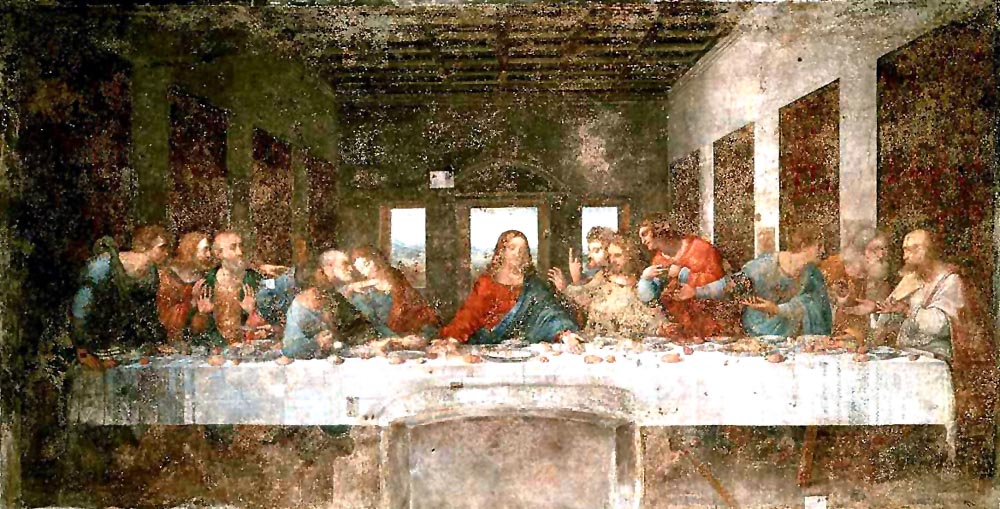
Devalued the dark medieval traditions in favor for renewal of ancient Greco-Roman culture. Michelangelo, Raphael, Leonardo Da Vinci were among the most famous Renaissance artists. A complete shift from medieval ideas, the Renaissance valued personal responsibility and knowledge. Major features of Renaissance art were realistic scenery, linear perspective, and chiaroscuro, contrast between light and dark paints. With the new concept of perspective, once flat images could be mathematically positioned and allow for more dimension and depth. Masaccio's Holy Trinity was the first to use perspective to accurately represent a space. The Church and the Medici family in Italy patronized artists to replace Byzantine mosaics with lively mythological and biblical sculptures and paintings. Masaccio, Donatello, da Vinci, and Michelangelo were patronized by the Medicis. One of the most famous paintings in the world is da Vinci's Last Supper. Michelangelo created the famous ceiling of the Sistine Chapel. A rival sculptor, Raphael, decorated the walls of the Vatican Library, featuring the School of Athens


Friday, November 7, 2014

Pre-Colombian Mesoamerica Podcast Q&A

1. How does the speaker define the area that is "Mesoamerica"?
Mesoamerica is defined by the speaker as the Mexico and Central America region. 
2. How did the topography of Mesoamerica impact civilizations?
Mesoamerica was a high plateau with mountains and slopes to sea level areas. This was important because the different landscape produced different resources and facilitated trade. 
3. What goods were produced in the highlands and lowlands?
The higher area in the center produce obsidian while the sloping lowlands produced seashells and feathers. 
4. Why was is so difficult to move goods in Mesoamerica?
There were few navigable rivers and no domesticated animals to carry goods by land. Goods were slowly moved by men or canoes. 
5. What accomplishments can we credit the Olmecs with?
The Olmecs carved huge stone heads and were the first to build ceremonial complexes for worship and pyramids. They invented the first ball game. They (not the Mayans) also invented the calendar and writing.  
6. Describe the Olmec calendar system.
There were two calendars, one solar of 365 days and one lunar of 260 days. Every 52 years, the first days of each calendar coincided. 
7. What was the purpose of Olmec pyramids?
Their pyramids were used for places of worship. 
8. How were Mayan pyramids different than Olmec pyramids?
They looked different from Olmec pyramids because they were steep and very narrow. 
9. Why was Mayan history "lost" at the time of contact?
After their collapse in the classical era, the Mayans abandoned their cities, but still existed. When the Spanish arrived, much of the Mayan writing could not be deciphered even by the Mayans themselves. So, we'll never fully understand their history. 
10. How does she say that the Aztecs were different than other mesoamericans?
The Aztecs were different because they were successful expansionists and aggressive tribute collectors. Though human sacrifice existed in all of the Mesoamerican civilizations, the Aztecs took that to an unprecedented scale.  
11. What was the purpose of the tribute systems of the Aztecs?
Their land could not produce enough food to support the growing Aztec civilization, so tribute systems were put into effect to collect food and money-making resources. 
12. Describe the Aztec creation myth.  
The Aztecs believed in this myth that said the world was created and destroyed four times and recreated by the sun god for the fifth time. The gods met together to create the world; one god was asked to throw himself in the fire to create the world, but he refused. Then, a lesser god threw himself into the fire. The other god was embarrassed to be shown up by a lesser god and threw himself into the fire as well. The two gods did not immediately create the sun and the moon because they waited for sacrifice. So, one by one, the gods had to each sacrifice themselves to make the sun and the moon rise. Sacrifice was essential to keep the world going.  
13. How was sacrifice of women different than men?
Men were sacrificed at the top of the pyramid and having their hearts cut out alive. Women, on the other hand, would dance at the base of the pyramid and be beheaded. 

Friday, October 31, 2014

Sui and Tang Dynasty Comparison Essay

The Sui and Tang ruled back to back and were similar in some ways and different in others. The Sui and Tang were similar in their collapses, but were different in their use of political power and effectiveness.

Both Sui and Tang dynasties were ruled by rulers who were partly nomadic.
The Sui and Tang families were not Han Chinese and came from northwestern China away from the Chinese heartland.

The collapse of the Sui and Tang dynasties were similar. Sui collapsed because the rulers ruthlessly imposed harsh taxes and dangerous construction projects on the people, which stirred disloyalty and frequent rebellion. Tang also ended due to the An Lushan Rebellion.

A difference between the dynasties was that the Tang held power much longer than the Sui did. The Sui dynasty only lasted thirty-six years while the Tang dynasty lasted almost three hundred. The Tang dynasty is considered a high point in Chinese civilizations, while Sui was only a short-lived, harsh, and ineffective dynasty like the Qin.

Another difference was that the Tang dynasty had an empress and the Sui never had a woman ruling. Empress Wu gained the throne by marrying into the royal family and ruled through Buddhism. However, Sui only had three male rulers.


Friday, October 24, 2014

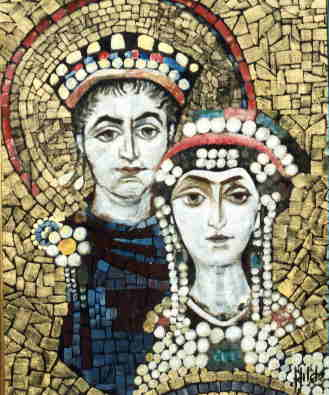
Emperor Justinian and the Byzantine Empire

Questions based on the Justinian I video

1. What's up with Justinian's wife, Theodora? She was an actress, which was a very low level class in Roman/Byzantine society, and a prostitute (burlesque dancing, bear dancing).
                                          
2. Why was Justinian unpopular? He heavily taxed his people to pay for the construction in Constantinople. Also, he controls and oppresses pagan celebrations, the study of ancient Greek philosophy, gambling, prostitute, adultery, homosexuality, any heretics, and Jews. 
                                                                     
3. What amazing fun things took place in the hippodrome? The Hippodrome was a circus that served as the sporting and social center and imperial propoganda of Constantinople. It featured horse racing and chariot racing.  
                      
4. What did Justinian do at the hippodrome? There were many people gathered at the hippodrome to oppose Justinian, which began violent riots and chaos that destroyed Constantinople. Justinian tells the rebels to meet him at the hippodrome for a compromise, but instead, orders his generals and troops to go to the hippodrome and massacre the rebels.     

5. Why did Justinian quickly move to rebuild Constantinople? Promptly after the massacre at the hippodrome, Justinian used this newly renewed absolutism to rebuild Constantinople modeled after him and his legacy to show the citizens that he was in control.  
               
6. What was the monumental architecture built in Constantinople? The Holy Church of Wisdom or the Hagia Sophia.  
          
7. What's unique about this building? It was the largest dome ever built. They used a never before accomplished architectural technique, pendentive, which constructed four massive arches on which the dome which rest with rounded triangles and semicircles around it. 
                                                             
8. How did Justinian ultimately cause the downfall of Byzantium? His constant military campaigning and work to rebuild Constantinople drained the economy of Byzantium. 


Friday, October 17, 2014

What's Rakestraw up to in St. Martin?

"No immature students, no exhausting papers to grade, no waking up at 5:30 in the morning... This is paradise," said Rakestraw to Anne as they looked at the magnificent beach view from their luxurious suite. The next day, they decided to go wakeboarding in the ocean. The water was especially clear and the weather was spot on. Starting the boat and driving far from the shore, Rakestraw and Anne were enjoying the salty breeze of the Caribbean. However, they, and the hundreds of other tourists and honeymooners on the beach, did not know the dangers that would come. While baking under the sun for a golden tan, Rakestraw noticed that the sun was no longer as intense and that the sky was getting darker. Rain began to pour as thunder rumbled in the sky. Suddenly, a huge wave overturned the boat, crushing it to bits. Rakestraw and Anne were tossed off the boat and into the salty sea. The wild maelstrom gulped the two little people, and soon enough, they were floating in the middle of the ocean. Rakestraw spotted a plank and held on to it while searching for Anne. Five minutes later, her head popped out of the water, and she grabbed onto the plank. The plank, however, was only large enough to fit one person. With much difficulty, Anne managed to climb on the plank, while Rakestraw was struggling to climb on. "This won't work!" he said, "Only one of us can sit on it." So, Rakestraw sacrificed himself to die and let his wife float back to shore.
The End


*OBVIOUS TITANIC REFERENCE
**BUT I HOPE YALL HAD AN AMAZING TIME AT ST. MARTIN AND I HOPE A HURRICANE DIDNT RUIN ANYTHING

Wednesday, October 1, 2014

Art of Classical Civilizations

Greek Art

The Golden Age of art began when Plato, Socrates, and Aristotle began teaching and plays became popular in Greece. There is clear Athenian influence on art because Athens dominated Greece. Athenian general Percoles promoted art and architecture and ordered the construction of the Parthenon with the gold and ivory statue of Athena. Other classical Greek art and sculptures such as The Birth of Athena and The Battle between Poseidon and Athena were once colorfully painted. During the Classical period, the creation and decoration of pottery dramatically changed. The pictures on the pottery displayed mythological scenes, everyday life, and comedians. Great bronze sculptures were made during this time. Although they appeared unnatural, they were very in proportion. Sculptures stopped the tradition of sculpturing ideal men and women and began to sculpt realistically; sculptures had expressive faces. The Aphrodite of Knidos was one of the greatest sculptures of this time; it popularized the contrapposto pose, which puts the weight on one leg, making figures seem relaxed. David by Michelangelo displayed this pose. The Corinthian columns were popular too. Friezes were carved in reliefs on temples; they displayed mythological scenes. The friezes on the Parthenon displays gods, warriors, musicians, heros, and elders. 

Roman Art

Roman art consisted of Doric, Ionian, and Corinthian columns and white busts of perfect men and women. Roman artists were influenced by the art of other empires such as the Etruscans. Artists were skilled in making clay sculptures and realistic depiction, a sign of heavy Greek influence on Roman art. However, Romans created much more realistic art and made sculptures bear great resemblance to the subject. Double chins, pockmarks, and receding hairline were all incorporated. Though sculptures displayed these imperfections, they still looked dignified and oppressive. Relief work was a distinctive style of Roman art and was displayed on temples and coins. Reliefs depicted military leader Augustus communicating with the gods and divine-like. Romans were also skilled architects. The discovery of concrete made the construction of arches, domes, and vaulted ceilings possible. The Pantheon, constructed with more than 5000 tons of concrete, is one the greatest domes in Rome. Its interior was marble, the heavier material was at its base, and the lighter material was at the top. The Colosseum was the greatest amphitheater in Rome and displays Doric, Ionian, and Corinthian column styles. It had intricate passageways, trapdoors, and pipes underground and a retractable roof. Wall art, preserved under ash in Pompeii, used white, yellow, and red as common colors and depicted mythological scenes. Scenes of battle and punishment became popular. Then, Christianity swept through Rome, and Roman art displayed Christian themes. 

Early Christian Art

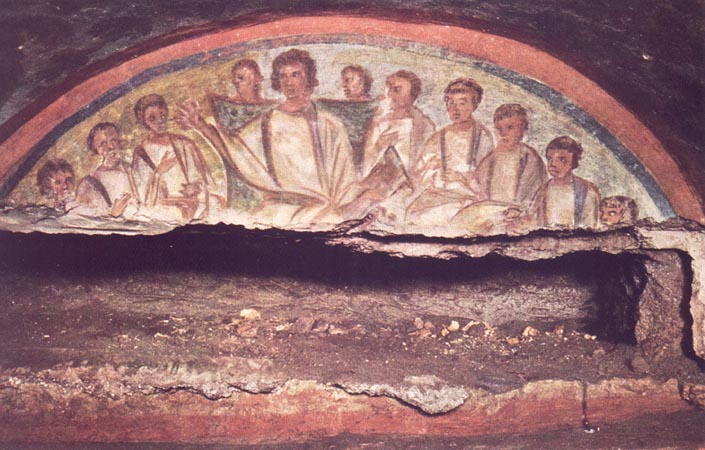
As Christianity spread, art forms changed from displaying humanistic pictures to more spiritual ones. Statues displaying religious aspects were not allowed, but relief sculptures and painting were fine. The artists of this time came from diverse cultural and religious backgrounds, so early Christian art style was completely new and combined of many different styles. Traditional Roman symbolism and pagan symbols were found in early Christian art. Modeling after the Romans, Christians began burying the dead in catacombs and decorating them. A common art form was the fresco, quickly painted and blended brushstrokes on top of another, giving it an impressionist rather than realistic look. On sarcophagi Christian sculptures carved historical and mythological scenes, portraits, animals, and nature motifs. The mix of Roman symbols and Biblical scenes such as Daniel and the Lion and Jonah and the Whale were also common. Unlike Christian art known today, early Christian art did not depict Jesus's crucifixion or the cross. Jesus was displayed as allegorical figures. Early Christian art was realistic and detailed, but size and position was distorted to show status. Since the cross could not be blatantly displayed, symbols of hidden crosses were common. After the Edict of Milan, Jesus, the cross, and other Christian symbols were clearly displayed in the form of colorful mosaics. 

Friday, September 26, 2014

BBC Confucianism Podcast

Confucianism 

Confucianism, a philosophy that originated in China during the Era of Warring States, was created by Kung Fu Tzu. He came from a class of scholars who based their teachings on their ideas; he and his disciples traveled around China spreading his ideas, which were not extraordinary at the time due to it being one of many ideas created by scholars. Confucius emphasized human interaction and a human society, and he claimed that he was a reformist of ideas from the Zhou Dynasty. Contrary to the supernatural beliefs of the previous dynasty, Confucius believed in a philosophy about people and how one treats another. His central ideas were to respect the social hierarchy, rituals, and parents. His ideas were a reiteration of what people knew, but since the political and social system had broken down during the Era of Warring States, he wanted China to return to its original state. He believed the key to good government was education, which was against the idea of sheer efficiency of that time. Once China became unified, the solution of keeping the empire unified was for the elite to be brought up by a standard education, which was the idea of Confucianism. Confucianism became more popular than the many other philosophical ideas of the time because of the work of Confucius's disciples. A strong bureaucracy, which was run by Confucians, sprung up because of Confucius's educational ideas that formed the examination system.