Thursday, April 2, 2015

OMG Eva Peron!

The BBC article describes what happened to the body of Eva Peron, wife of Argentinian militaristic "President" Juan Peron in 1940s.  She was wildly popular among her people, campaigning and earning support for her husband. Despite this, there were still grounds of anti-Peronist military officers seeking the downfall of the Peron. When she died in 1952 from cancer, two million supporters attended her funeral with candles and flowers. Her body, however, was soon taken far away from Argentina by anti-Peronists.

Interestingly enough, she was buried in Milan under a false name. Back at home, Argentina was in a state of economic and political turmoil. Once the Peronist Party was legalized, they returned her body to Juan who lived in Spain. Juan and his new wife Isabel took meticulous care of her body, which had marks of being seriously hit and even signs of her body being stuffed in a coffin too small. The internal embalming held its place still. Isabel was dedicated to restoring and displaying Eva's body (which is awkward because wife to ex-wife relation...) Eva Peron's body is now deeply buried in a foil-proof, air-tight crypt in Buenos Aires so that her body would never be disturbed again.

Thursday, March 26, 2015

Wow Description of 42 VOX Maps about WWI, WWII, and Aftermath!!....

http://www.vox.com/2014/11/13/7148855/40-maps-that-explain-world-war-ii

Map 1: shows powers and different sides of WWII
Map 2: shows GDP of major powers before WWII with USA, Germany, and USSR leading. Also shows the contrast between high GDP of allies to low GDP of axis powers.
Map 3: shows the drawing of European territories after Germany lost in WWI. Germany and Austria Hungary shrank significantly.
Map 4: shows Japan occupation of northeast China leading up to war in 1937.
Map 5: shows the high concentration of German speakers along the borders of Czechoslovakia and very low concentration in the center.
Map 6: map on left shows the planned territorial split between Germany and USSR. Map on right shows how Russia took more of Poland than was agreed.
Map 7: shows the path of Russian troops invading Finland
Map 8: shows Western Front fighting along Franco-German border and German gains of east France in WWI.
Map 9: shows how German troops closed in along Belgium and the path of British soldiers forced to flee.
Map 10: shows planned out German invasion of Britain through the English Channel (though failed)
Map 11: shows densely dotted Britain, marking points where Hitler bombed and planned to bomb during WWII
Map 12: shows how a treaty between France and Germany in WWII split France into German-occupied north, free south, and some Italian-occupied area in the southeast.
Map 13: shows Hitler's invasion of Russia, eastern front, after betraying Stalin.
Map 14: shows German plan of surrounding and attacking Leningrad, Russia
Map 15: shows Hawaii and battle events and routes of Japan's attack on Pearl Harbor
Map 16: shows Japanese attack of imperialism in Southeast Asia
Map 17: shows route of Japanese invasion of Philippines, known as the Bataan Death March
Map 18: shows defeat and retreat of Hitler's troops from Leningrad, Russia
Map 19: shows offensive takes on North Africa by Britain and later, German offensive taking North Africa from Britain.
Map 20: shows French prime minister de Gaulle's imperialism of the world; Africa and Asia one by one conquested in the 1940s.
Map 21: shows places in Italy where Allied forces attacked
Map 22: shows Allied naval forces arriving at the shores of Normandy to retake France from Axis.
Map 23: shows Axis retreats from previously occupied Allied countries and retaking of countries by Allied forces by 1940s.
Map 24: shows difference of casualties in WWII in the world; Russia suffered the largest with Germany as second.
Not map Map  25: shows new use of aircraft technologies in WWII
Map 26: shows the use of radar technologies over Britain during Germany's planned invasion.
Map 27: shows key sites of American development and research of atomic bombs, known as the Manhattan Project. Included Richland, Washington, Oak Ridge, Tennessee, and Los Alamos, New Mexico.
Map 28: shows the map of the grounds of Bletchley Park near London, England, which was a major code-breaking center.
Map 29: shows the parts of a German V-2 rocket, which was used on the Allies though not very reliable and very expensive.
Map 30: shows routes of US and Japanese naval forces in the Battle of Midway in the Pacific Ocean. Japan faced fatal blows in the battle.
Map 31: shows another map of routes of US and Japanese naval and air forces in Leyte Gulf near the Philippines.
Map 32: shows area of Tokyo, Nagoya, and Kobe burned out and devestated by American bombers.
Map 33: shows the extent and range of damage of the US atomic bomb dropped in Hiroshima, Japan.
Map 34: shows the percent of Jews killed in Nazi concentration camps in central-eastern Europe. Most being in Germany, Poland, and Czechoslovakia where 80-90% Jews were killed.
Map 35: shows post-war Israeli-Arab conflict; UN planed to split Palestine into a Jewish and an Arab state. It also shows the reality of Arab armies invading Palestine and Israelis counterattacking, pushing Arabs out.
Map 36: shows Germany divided into zones of influence- Britain in northwest, France southwest, USA southeast, and Soviet communists in the northeast.
Map 37: shows the phases of the Korean War- the Korean peninsula is originally dominated by Communist forces, then UN forces take the peninsula, then North and South Korea are divided with an Armistice Line.
Map 38: shows that starting from 1950, European countries lose their African holds one by one after the war.
Map 39: shows many US military bases in Germany, especially in the south, to prevent another militarist regime.
Map 40: shows a few US military bases scattered in Japan.
Map 41: shows the European Union beginning with Western European countries in 1957, then spreading east until 2013. Neither Russia nor south eastern Europe are in the EU.
Map 42!!!!!!!!!!!!!!!!!!!!!!!!!!!!!!!!!!!!!!!!!!!
shows the number of UN member countries increasing, beginning with only the Americas, Europe, and parts of Asia to including the entire world by the 2000s.

The END

Wednesday, March 4, 2015

Blog 3.4 Industrial Revolution

Europe:
1. What was the impact of European population growth on industry?    
The population growth provided giant reservoir of workers for emerging industries. 
2. What were the results of the first organization of workers? 
They were successful in demanding higher wagers and shorter working day.                  
3. Why did industry reach the Netherlands so relatively late?        
The country had few natural resources and covered in waterways, making factory and railway construction difficult.            

Belgium
4. How did Napoleon impact the development of industry in Belgium? 
He conquered the country and abolished old guilds and introduced free trade, opening up industries.  
5. Which industries developed in Belgium?  Why did those develop? 
Coal and steel (large natural supply and used for building and fuel), textile (Britain installed spinning machines in the country), canal and railway building (because of British investments and high demand for goods by less developed neighbors), soda (to make glass, soap, and chemicals.)        
6. How did infrastructure in Belgium improve?  
Canal and railway building boom in 1840s.        
                                  
France
7. What characteristics in France discouraged industrial innovation?  
France did not possess as large and accessible coal or iron ore like Great Britain or Belgium. French agriculture was prosperous and prevented the need for industry for a longer time. 
8. How did French social structures dictate which industries developed?
Farmers and peasants were freed from taxes and debts in 1789, so they remained being farmers and peasants. The aristocracy were the ones who created some industry, and they molded them on their wishes. So, material goods such as furniture and porcelain, leather goods and silk, and clocks were the first things that developed. 
9. Which industries developed in France late? Why did it happen late?  
Canal and road building, coal, and iron. The 1789 revolution abolished old guild restrictions and internal tariffs. Currency was stabilized and Bank of France was created created. 

Germany
10. Why did industrial development occur late in Germany?
It had been divided into many small states and traditional guild privileges limited industrialization.                       
11. What was the impact of the German Customs Union?   
It abolished trade barriers between German states, allowing free market competition to promote industrialization. 12. In which industries did Germany become the leader in Europe?        
Railways, chemical and electrical engineering. 

Great Britain
13.  Which other industries developed because of the steam engine?     
(no more questions for Britain, that part's all in the book.)    
Cotton textile, railway, water travel (steamships, canals)   
                  
Luxembourg 
14. How did Luxembourg benefit from German industrialization? 
Its economy benefited from the German Customs Union. Coke for blast furnaces came from Germany, so it depended on German's success in iron and steel work to prosper itself.            
15. Why were they so successful at producing iron?
The steam engine and blast furnace arrived from Belgium, causing an iron boom. There were also rich deposits in South Luxembourg and Lorraine.        
                             
Netherlands 
16. Was the Netherlands' economic success before industrialization        
something that helped industry develop or slowed development?  Why? 
Slowed its development because Netherlands already had sophisticated technologies of hydraulic engineering such as the use of windmills. So, new British technologies spread slowly to the Dutch. 
17. Which industries did develop in the Netherlands?       
Industries that processed agrarian goods: distilleries, breweries, oil processing. 
                          
Norway
18. What were the earliest industries in Norway?
Small soap, brick, glass, iron, and beer industries.                                            
19. How did water power development change Norway's economy?        
Norway had greatest potential for water potential, and soon used osmosis to mix fresh and salt water to create energy. This soon led to mass production of carbide, zinc, tin, steel, ferrosilicon, and fertilizer in industries now that energy was cheap and abundant. 
 
Spain 
20. What kinds of mining industries were successful in Spain? 
Iron mining in the Basque Country, coal mining in Asturias, cinnabar mines (mercury) in Almaden, copper mines, lead mines, gold, silver, sulfur in Andalusia, huge silver mining in Murcia                  

Blog 3.5 Oklahoma's Ban on AP U.S. History

Recently, Oklahoma tried to pass a bill to ban AP US History after College Board replaced their list of topics for the course with more specifics; critics argue that the changes include too many negative aspects of American history and should focus more on its positive aspects to promote patriotism. The new framework is explicit in what students should learn. However, traditional aspects of history such as George Washington and the Holocaust are absent from this new list, causing attacks from the Republican National Committee, who state these new objectives make students hate America. Historians defend the new framework for reflecting the complex truths of American history.

It is not the first time that topics taught in US history has sparked controversy. The Confederate states rejected textbooks favoring the Union and abolition of slavery, the slightest favor toward the British during the American Revolution sparked panic, criticism of laissez-faire led to Communist name calling. So, this new framework of the AP US history curriculum is nothing new. Deciding if some of the topics College Boards wants students to learn are offensive or not is entirely subjective and dependent on the state; in my opinion, the ban is Oklahoma's loss. It is not interesting, realistic or helpful to avoid specific details (that may or may not put America in a bad light) and to teach students what they already know since kids in America have been taught to feel patriotic and know major figures and events in American history.

Friday, January 30, 2015

Comparison Essay

Comparing the American Revolution and the French Revolution

The causes of both revolutions were similar in that they dealt with economic hardships and desire for political influence. The main difference between the two revolutions was that the result of the American Revolution was a successful, independent republic, while the result of the French Revolution was a republic that did not solve any problems and made things worse.

Both revolutions were caused by economic crisis. After the Seven Years War, Britain was in post-war debt and levied the Stamp Act, Sugar and Molasses Act, and Tea Act on the colonies, which sparked colonial protest and boycotts and and bred dissatisfaction. The Seven Years War also caused economic debt in France. Financial aid to the American Revolution worsened the debt. When the Estates General and the monarch could not create a successful tax levy and bread prices continued to soar, the peasants and urban workers attacked the Bastille.

Another similarity was that both American and French revolutionaries wanted to improve their political status and have a more constitutional government. American colonists wanted political freedom to elected their own government instead of having a monarch rule across the Atlantic Ocean. The French third estate was unsatisfied with their little political influence despite having wealthy and intellectual members. They organized the National Assembly to protect the interests of the third estate, which was the majority of the people, against King Louis XVI. The reason why the ideas of reforming the monarchy was common among both Americans and French was because the Enlightenment brought up ways to improve the government.

Both revolutions led to ill-treatment of loyalists or monarchy supporters. When the American rebels won, they were supposed to return Loyalist land under the Treaty of Paris, but in reality, the Loyalists were so badly treated by the victorious rebels that most of them were exiled to Canada. Many members of the royalists and moderate (Girondist) groups of French society fled France or were killed by the guillotine when the Revolution entered the Reign of terror phase.

One difference was the outcome of the American Revolution created a lasting republic, while the French Revolution created a meager republic followed by a dictatorship. After the colonists won, state and federal governments were set up that had a balance of power between the executive and legislative branches. Although changes in the system occurred, the governments remained a republic. After Louis XVI was killed, the French Republic was created, but it was far from being a republic since Jacobins randomly killed anyone who they suspected as enemy of the Republic. This Republic did not solve any of the economic crisis, nor did the following Directory, which led to Napoleon establishing a military dictatorial empire.

Another difference was that the American Revolution was more organized and war-like than the radical, bloody French Revolution. The American colonists organized the Continental Army and fought with Britain until the Treaty of Paris was reached. The French Revolution began with bloody riots and eventually the Reign of Terror, which was the execution of thousands of innocent people.

The American Revolution drew supporters from other countries, while the French Revolution only made other European nations afraid and against France. Native Americans aided both the colonial and British side, and France allied with America. When the colonists won, Europeans were fascinated with and inspired by the new country. On the other hand, European countries such as Austria and Prussia threatened to stop the revolutionaries and help the French monarch when the Revolution began to get radical. The reason why other countries helped the American Revolution but not the French was that the Americans fought for the glorified idea of independence and democracy, and their methods were stately. European states were appalled at the aimless mass killing of people by the Jacobins and allied against France in case its radical methods spread to their countries.

Friday, January 16, 2015

Art in the Ottoman and Mughal Empires

Ottoman Empire Art

Ottoman art was influenced by Seljuk, Byzantine, Persian, and Mamluk cultures. Mosques had vast inner spaces surmounted by massive domes, corner minarets, columns, and a constrast between light and shadow. Kulliyes, a complex of buildings centered around a mosque, was another characteristic. Ottoman architecture remained uniform over time. The Hagia Sophia church and the Selimiye Mosque in Edirne are some of the most important models for Ottoman mosques. Miniature paintings, influenced by Persian, Byzantine, and Chinese art, were often in shades of bright red, green, and blue. A key feature in Ottoman art was the use of abstract topics as opposed to human figures. Carpet weaving, jewelry making, paper marbling, Iznik ware ceramics were also created in the Ottoman Empire. Carpets, often made of silk and cotton, were used on both floors and wall/ door hangings. Hereke silk carpets were the most valued of all Ottoman carpets. 

Mughal Empire Art

Mughal art styles borrowed from the Renaissance and Persian/ Indian sources. Massive and lavish monuments and palaces were built by Muslim emperors such as Humayun's Tomb. During the golden age of Mughal art, many splendid monuments such as the Pearl Mosque, the Red Fort, and Taj Mahal were erected. The famous Taj Mahal, known for its symmetry, had large, white marble stands with an arch shaped doorway topped by a large dome and finial. Mughal paintings borrowed individual and naturalistic motifs of the Renaissance and Mannerist styles, but also Indian and Persian traditions. Miniature paintings that depicted scenes of court life, wildlife, hunting, and battles were common in classic works of Persian and Indian texts.


Friday, January 9, 2015

HBD to the Magna Carta

Back in thirteenth century England, there was rising tension between the dictator-like King John and the barons. First of all, John expelled monks in Canterbury, so the pope excommunicated. On top of that, barons were talking bad of him via Shakespeare since they were being suppressed; they could not celebrate mass, so many fled to neighboring countries. These countries conspired against England. Thus, King John was forced to surrender to the barons and the pope and signed the Magna Carta. During that time period, the Magna Carta was nothing special. In fact, it was a failure since no king in his right mind conformed to its terms of giving the barons right to seize all the king's possession if he broke any of the other laws. When John broke the Magna Carta's terms, French king Louis came to England under the support of the barons to take the throne. In the end, John died. His son Henry had a regent, William Marshal, who reissued the Charter to become the monarchy's most powerful weapon. Centuries later, the Magna Carta was once again revived by Edward Coke, a parliamentarian during the English Civil War. 
1. OMG what was the king's hostage doing to her son??!!??!
SHE WAS EATING HIM OMG EW!
2. At the time, what was England's relationship with its neighbors? Not very good at all; France, Wales, Scotland, and Rome all conspired to overthrow the monarchy in England. Also, King John alienated the papacy. 
3. Why did King John agree to the Magna Carta? He was faced with the threat of invasion by those countries in #2 because of all the baron's complaints and dissatisfaction.
4. What was the impact of the Magna Carta at the time? It was nothing new and pretty much a failure. 
5. How did later kings use the charter to their advantage? When John died, his son's regent William Marshal defeated the rebels by reissuing the Charter that turned it from weakening king into monarchy's most powerful weapon. 
6. How did Edward Coke revive the importance of the charter? He was a leader of the parliamentaries during the English Civil War and revived the charter by using it against King James I and as the basis of the Petition of Right. 
7. How did American colonial leaders use the Magna Carta? The colonists were inspired by Coke and valued the Magna Carta in creating their government. So, they used the Magna Carta as inspiration of the right of freedom during the American Revolution against Britain. 
8. Why is the Magna Carta more important to modern Americans     
than to the British? The constitutional framework of America is taken from the core concepts of the Magna Carta and is embedded in the perception of justice and law of Americans. 

Friday, December 12, 2014

Failed Colonies of America

Fort Caroline
  1. What insights do you gain from comparing the French and Spanish accounts of the 1565 attack?                       Spanish account that attack as glorious and ennobling. They focus on the general who had ordered the slaughter of French Lutherans as merciful and resilient. On the other hand, the French describe the brutishness of the Spanish through imagery of the slaughter: "...killing all whom they found, so that awful outcries and groans arose from those who were being slaughtered." 
  2. How do they decide what is ethically and politically acceptable in their actions and in the actions of their enemies? The Spanish believe that the killing of Frenchmen was justified because they were Lutherans or "enemies of God." The French also accept their fate, blaming their own sins not the Spanish. The Spanish believe that taking the enemy's fort is good because they gain valuable cargo and allow them to spread the holy Gospel. The Spanish do not accept any Lutherans and only spare the French Catholics. 
Fort Caroline and Ajacan

  1. What do the settlers see as the strengths and weaknesses of their colonies? A weakness of Ajacan was the scarcity of food, which lead to famine and death. However, the settlers of Ajacan benefited from the kindness of the Indians there, who gave them info about the land. The weakness of Fort Caroline for the French was the unpredictable weather; a hurricane destroyed many of their ships while they were going to attack the Spain.
  2. Which do they ascribe to external factors? to themselves? The French attribute external factor of the hurricane to their inability to attack the Spaniards first. They also blame themselves for being too trusting of the Spanish. The soil of Ajacan was poor and could not produce enough food for the settlers. The settlers also blame themselves for being unwise when dealing with the Indians. The settlers did not give the Indians anything in return, so their food was taken away. 
  3. Evaluate the colonists' planning for the settlements. How do they adapt to unforeseen problems? The settlers decide to continue settling on the land the Indians gave to them and learned how to wisely barter with the Indians. The French abandon their colony and admit to defeat by the Spanish. 
  4. How did colonists' relationships with the Indians affect their fate? At first, the colonists' benefited from the Indians, who gave them food and tips on where was the best to settle. However, the downfall of the bartering alliance comes from them not repaying the Indians. 
  5. How did their perception of natural environment affect their fate? The settlers did not expect the environment of Ajaca to be so poor, and they had adversities until the Natives helped them. 
  6. How did the leadership in each colony affect its fate? The leader of Ajaca was Father Segura, and he forbade the settlers from giving anything to the natives, which led to their loss of the Indian's help. The leader of French Fort Caroline was Ribaud. He was too naive and trusting toward the Spanish, and this caused him and almost all other of his followers to be killed. 
  7. What is critical for a successful colony? Choosing the right region and which season to settle is crucial because this determines the amount of available resources. Having a prudent and diplomatic leader is also important. 
Fort Caroline and Roanoke
  1. To what extent did the colonists prepare for failure? Upon knowing that their battle ships were destroyed, some of the French prepared for defeat and abandoned Fort Caroline to return to France, while other stayed behind only to meet failure. The colonists at Roanoke abandoned the site. 
  2. How did the colonies end? Roanoke was abandoned without any sign of distress. Fort Caroline was seized by the Spanish from the French. 
  3. How might these accounts differ from those of successful colonies? These accounts describe America environment to be very different from the unrealistic descriptions of America back in Europe. These accounts recall the struggles of the colonists, while successful stories only focused on the reward and outcome. 
Fort Caroline, Ajacan, Roanoke
  1. What might have saved these colonies? A region with better resources and not near any rival colonies such the Spaniards. 
  2. What might a prospective settler learn from these documents? A settler might learn the risks of colonization and learn to plan ahead extensively. One should bring lots of supplies in case of poor environment. 
  3. How did European rivalries affect the fate of these colonies? The rivalries between the expansion zeal of Spain, England, and France cause each to kill off one another's colonies. The colonies were subject to attacks by another country's colonies. 

Friday, December 5, 2014

BBC Summary

The Execution of Charles I 

The execution of King Charles I was actually not favored in the hearts of the English. Many people stated that they wanted to execute the king, but they were pressured by the influential Oliver Cromwell and regretted their actions. Regicide was quite shocking in the minds of Europeans. Two members of the Rump Parliament, Thomas Hoyle and Rowland Wilson, committed suicide out of guilt for killing the king. The Old Testament instilled the idea of regicide in people with stories of unrighteous kings being overthrown by God's people. Puritans believed in regicide because they believed that the Scriptures provided the blueprint for politics and the justice for people to overthrow their authorities. Thomas Dugard, a moderate parliamentarian, preached that Charles I's Book of Sports as sinful and cause of bloodshed because it allowed licensed recreations on Sabbath Sundays. Thus, people believed that Charles had provoked God's wrath. 

Educated Englishmen saw Charles as Caligula, an ancient Roman tyrant since universities familiarized them with republican understanding of politics and corruption of government. They advocated monarchical republics such as the reign of Elizabeth I when the landowning men could participate in legal and political affairs. The experience of civil was cost many lives and money. Taxation broke records and troops that lacked pay plundered helpless commoners. The result of the war was people demanding rewards for all their sacrifices. Additionally, the idea that God was punishing the king was strengthened when Charles lost the war. 

The Parliamentary army changed politics in England in the Declarations of Parliament, which defended people's just rights and liberties while stating the duty to overthrow Charles for his perfidy. Trial of the king for crimes against his people and laws of England had real basis, and it was decided that Charles should be executed in the face of the world. After Charles's execution, the people developed a radical view of government. The purged Parliament wanted to abolish monarchy altogether and govern by its own representatives or national meetings in council. 

Friday, November 21, 2014

Medieval, Gothic, and Renaissance Art

Medieval Art

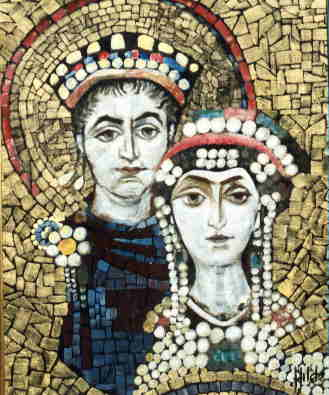
There were eight artistic movements: Byzantine, Islamic, Viking, Carolingian, Celtic, Ottonian, Romanesque, and Gothic art. Medieval art represents the popularity of Christianity. Since the Bible prohibited graven images, artists avoided sculptures that could be viewed from all around and tended toward one dimensional art. Islamic art was known for tessellated patterns, depiction of heaven as a flowering place, geometric forms, and calligraphy. The vikings excelled in wood and metal work , and golden brooches were common. During the Carolingian period, many extravagant churches with luxuries were created. Contrary to Byzantine art, Carolingian art used human forms. Illuminated manuscripts of religious texts were common for artists to embellish in. Celtic art was influenced by geometry and animal depictions. Ottonian art took on a Germanic style. Romanesque architecture gained popularity by 1000 AD. Frescos and reliefs were common on church walls. Inspired by painter Giotto, Gothic art was more realistic than its predecessors. Key change in architecture was incorporation of sculptures as architectural elements. 


Gothic Art

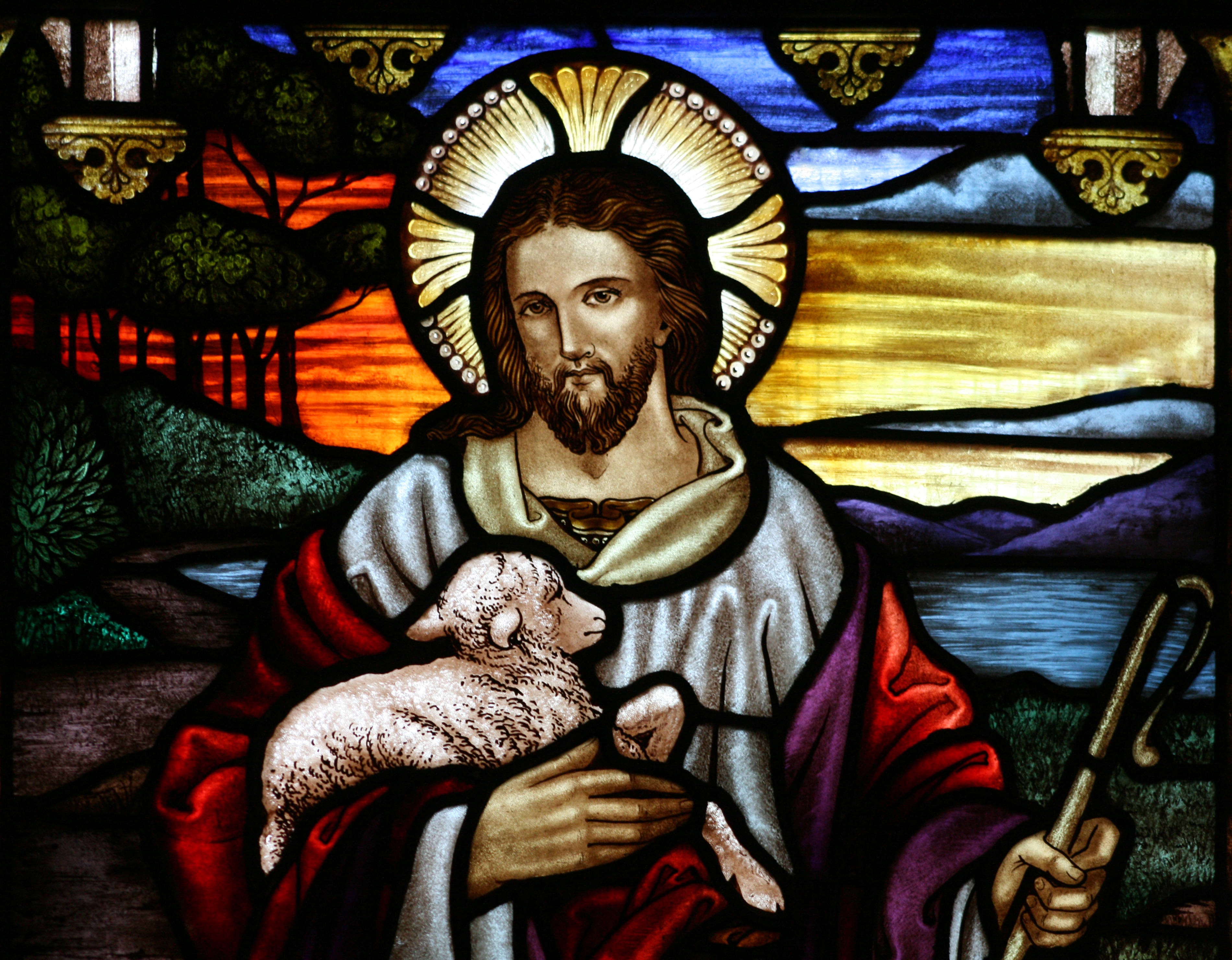
From France, Gothic art made cathedrals and stained glass windows larger than ever before. It strayed from imitations of classical Roman art. Gothic style was influenced by Romanesque style; however, Gothic cathedrals were very high unlike the short and wide ones in Romanesque. Distinctive traits of Gothic art were the ribbed vault, flying buttress, and pointed arch. Architectures competed to build cathedrals taller and taller. The French cathedral of Saint Denis is the best known model of Gothic cathedrals. It served as burial place for kings. The naturalistic style remained dominant. Stained glass window in Gothic design was known as the rose window. Illuminated manuscripts were highly decorated with intricate borders, and the most famous artists of these were the Limbourg brothers, known for painting Jean de France's Book of Hours. Christ was always symbolized as the lamb in these books. Calligraphy remained predominant in all Gothic art. 

Renaissance Art

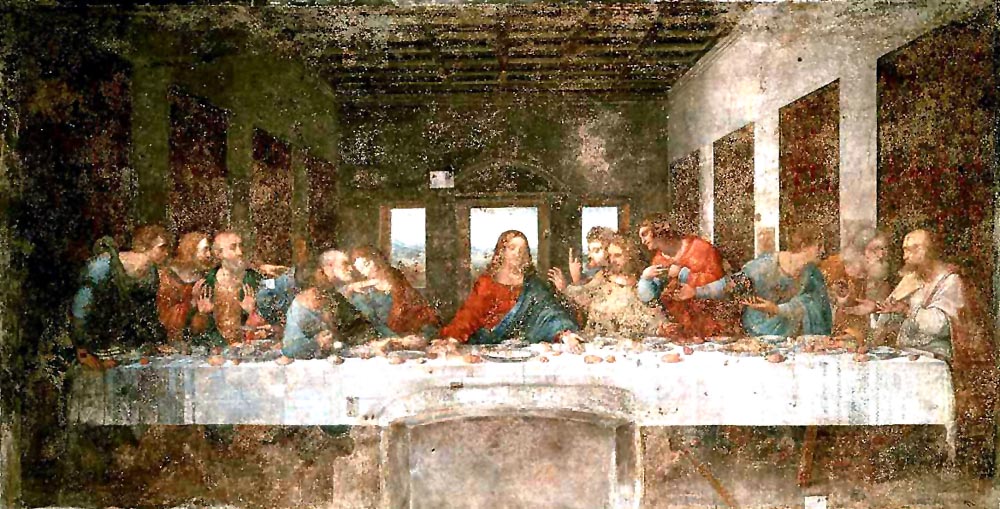
Devalued the dark medieval traditions in favor for renewal of ancient Greco-Roman culture. Michelangelo, Raphael, Leonardo Da Vinci were among the most famous Renaissance artists. A complete shift from medieval ideas, the Renaissance valued personal responsibility and knowledge. Major features of Renaissance art were realistic scenery, linear perspective, and chiaroscuro, contrast between light and dark paints. With the new concept of perspective, once flat images could be mathematically positioned and allow for more dimension and depth. Masaccio's Holy Trinity was the first to use perspective to accurately represent a space. The Church and the Medici family in Italy patronized artists to replace Byzantine mosaics with lively mythological and biblical sculptures and paintings. Masaccio, Donatello, da Vinci, and Michelangelo were patronized by the Medicis. One of the most famous paintings in the world is da Vinci's Last Supper. Michelangelo created the famous ceiling of the Sistine Chapel. A rival sculptor, Raphael, decorated the walls of the Vatican Library, featuring the School of Athens. 


Friday, November 7, 2014

Pre-Colombian Mesoamerica Podcast Q&A

1. How does the speaker define the area that is "Mesoamerica"?
Mesoamerica is defined by the speaker as the Mexico and Central America region. 
2. How did the topography of Mesoamerica impact civilizations?
Mesoamerica was a high plateau with mountains and slopes to sea level areas. This was important because the different landscape produced different resources and facilitated trade. 
3. What goods were produced in the highlands and lowlands?
The higher area in the center produce obsidian while the sloping lowlands produced seashells and feathers. 
4. Why was is so difficult to move goods in Mesoamerica?
There were few navigable rivers and no domesticated animals to carry goods by land. Goods were slowly moved by men or canoes. 
5. What accomplishments can we credit the Olmecs with?
The Olmecs carved huge stone heads and were the first to build ceremonial complexes for worship and pyramids. They invented the first ball game. They (not the Mayans) also invented the calendar and writing.  
6. Describe the Olmec calendar system.
There were two calendars, one solar of 365 days and one lunar of 260 days. Every 52 years, the first days of each calendar coincided. 
7. What was the purpose of Olmec pyramids?
Their pyramids were used for places of worship. 
8. How were Mayan pyramids different than Olmec pyramids?
They looked different from Olmec pyramids because they were steep and very narrow. 
9. Why was Mayan history "lost" at the time of contact?
After their collapse in the classical era, the Mayans abandoned their cities, but still existed. When the Spanish arrived, much of the Mayan writing could not be deciphered even by the Mayans themselves. So, we'll never fully understand their history. 
10. How does she say that the Aztecs were different than other mesoamericans?
The Aztecs were different because they were successful expansionists and aggressive tribute collectors. Though human sacrifice existed in all of the Mesoamerican civilizations, the Aztecs took that to an unprecedented scale.  
11. What was the purpose of the tribute systems of the Aztecs?
Their land could not produce enough food to support the growing Aztec civilization, so tribute systems were put into effect to collect food and money-making resources. 
12. Describe the Aztec creation myth.  
The Aztecs believed in this myth that said the world was created and destroyed four times and recreated by the sun god for the fifth time. The gods met together to create the world; one god was asked to throw himself in the fire to create the world, but he refused. Then, a lesser god threw himself into the fire. The other god was embarrassed to be shown up by a lesser god and threw himself into the fire as well. The two gods did not immediately create the sun and the moon because they waited for sacrifice. So, one by one, the gods had to each sacrifice themselves to make the sun and the moon rise. Sacrifice was essential to keep the world going.  
13. How was sacrifice of women different than men?
Men were sacrificed at the top of the pyramid and having their hearts cut out alive. Women, on the other hand, would dance at the base of the pyramid and be beheaded. 

Friday, October 31, 2014

Sui and Tang Dynasty Comparison Essay

The Sui and Tang ruled back to back and were similar in some ways and different in others. The Sui and Tang were similar in their collapses, but were different in their use of political power and effectiveness.

Both Sui and Tang dynasties were ruled by rulers who were partly nomadic.
The Sui and Tang families were not Han Chinese and came from northwestern China away from the Chinese heartland.

The collapse of the Sui and Tang dynasties were similar. Sui collapsed because the rulers ruthlessly imposed harsh taxes and dangerous construction projects on the people, which stirred disloyalty and frequent rebellion. Tang also ended due to the An Lushan Rebellion.

A difference between the dynasties was that the Tang held power much longer than the Sui did. The Sui dynasty only lasted thirty-six years while the Tang dynasty lasted almost three hundred. The Tang dynasty is considered a high point in Chinese civilizations, while Sui was only a short-lived, harsh, and ineffective dynasty like the Qin.

Another difference was that the Tang dynasty had an empress and the Sui never had a woman ruling. Empress Wu gained the throne by marrying into the royal family and ruled through Buddhism. However, Sui only had three male rulers.


Friday, October 24, 2014

Emperor Justinian and the Byzantine Empire

Questions based on the Justinian I video

1. What's up with Justinian's wife, Theodora? She was an actress, which was a very low level class in Roman/Byzantine society, and a prostitute (burlesque dancing, bear dancing).
                                          
2. Why was Justinian unpopular? He heavily taxed his people to pay for the construction in Constantinople. Also, he controls and oppresses pagan celebrations, the study of ancient Greek philosophy, gambling, prostitute, adultery, homosexuality, any heretics, and Jews. 
                                                                     
3. What amazing fun things took place in the hippodrome? The Hippodrome was a circus that served as the sporting and social center and imperial propoganda of Constantinople. It featured horse racing and chariot racing.  
                      
4. What did Justinian do at the hippodrome? There were many people gathered at the hippodrome to oppose Justinian, which began violent riots and chaos that destroyed Constantinople. Justinian tells the rebels to meet him at the hippodrome for a compromise, but instead, orders his generals and troops to go to the hippodrome and massacre the rebels.     

5. Why did Justinian quickly move to rebuild Constantinople? Promptly after the massacre at the hippodrome, Justinian used this newly renewed absolutism to rebuild Constantinople modeled after him and his legacy to show the citizens that he was in control.  
               
6. What was the monumental architecture built in Constantinople? The Holy Church of Wisdom or the Hagia Sophia.  
          
7. What's unique about this building? It was the largest dome ever built. They used a never before accomplished architectural technique, pendentive, which constructed four massive arches on which the dome which rest with rounded triangles and semicircles around it. 
                                                             
8. How did Justinian ultimately cause the downfall of Byzantium? His constant military campaigning and work to rebuild Constantinople drained the economy of Byzantium. 


Friday, October 17, 2014

What's Rakestraw up to in St. Martin?

"No immature students, no exhausting papers to grade, no waking up at 5:30 in the morning... This is paradise," said Rakestraw to Anne as they looked at the magnificent beach view from their luxurious suite. The next day, they decided to go wakeboarding in the ocean. The water was especially clear and the weather was spot on. Starting the boat and driving far from the shore, Rakestraw and Anne were enjoying the salty breeze of the Caribbean. However, they, and the hundreds of other tourists and honeymooners on the beach, did not know the dangers that would come. While baking under the sun for a golden tan, Rakestraw noticed that the sun was no longer as intense and that the sky was getting darker. Rain began to pour as thunder rumbled in the sky. Suddenly, a huge wave overturned the boat, crushing it to bits. Rakestraw and Anne were tossed off the boat and into the salty sea. The wild maelstrom gulped the two little people, and soon enough, they were floating in the middle of the ocean. Rakestraw spotted a plank and held on to it while searching for Anne. Five minutes later, her head popped out of the water, and she grabbed onto the plank. The plank, however, was only large enough to fit one person. With much difficulty, Anne managed to climb on the plank, while Rakestraw was struggling to climb on. "This won't work!" he said, "Only one of us can sit on it." So, Rakestraw sacrificed himself to die and let his wife float back to shore.
The End


*OBVIOUS TITANIC REFERENCE
**BUT I HOPE YALL HAD AN AMAZING TIME AT ST. MARTIN AND I HOPE A HURRICANE DIDNT RUIN ANYTHING

Wednesday, October 1, 2014

Art of Classical Civilizations

Greek Art

The Golden Age of art began when Plato, Socrates, and Aristotle began teaching and plays became popular in Greece. There is clear Athenian influence on art because Athens dominated Greece. Athenian general Percoles promoted art and architecture and ordered the construction of the Parthenon with the gold and ivory statue of Athena. Other classical Greek art and sculptures such as The Birth of Athena and The Battle between Poseidon and Athena were once colorfully painted. During the Classical period, the creation and decoration of pottery dramatically changed. The pictures on the pottery displayed mythological scenes, everyday life, and comedians. Great bronze sculptures were made during this time. Although they appeared unnatural, they were very in proportion. Sculptures stopped the tradition of sculpturing ideal men and women and began to sculpt realistically; sculptures had expressive faces. The Aphrodite of Knidos was one of the greatest sculptures of this time; it popularized the contrapposto pose, which puts the weight on one leg, making figures seem relaxed. David by Michelangelo displayed this pose. The Corinthian columns were popular too. Friezes were carved in reliefs on temples; they displayed mythological scenes. The friezes on the Parthenon displays gods, warriors, musicians, heros, and elders. 

Roman Art

Roman art consisted of Doric, Ionian, and Corinthian columns and white busts of perfect men and women. Roman artists were influenced by the art of other empires such as the Etruscans. Artists were skilled in making clay sculptures and realistic depiction, a sign of heavy Greek influence on Roman art. However, Romans created much more realistic art and made sculptures bear great resemblance to the subject. Double chins, pockmarks, and receding hairline were all incorporated. Though sculptures displayed these imperfections, they still looked dignified and oppressive. Relief work was a distinctive style of Roman art and was displayed on temples and coins. Reliefs depicted military leader Augustus communicating with the gods and divine-like. Romans were also skilled architects. The discovery of concrete made the construction of arches, domes, and vaulted ceilings possible. The Pantheon, constructed with more than 5000 tons of concrete, is one the greatest domes in Rome. Its interior was marble, the heavier material was at its base, and the lighter material was at the top. The Colosseum was the greatest amphitheater in Rome and displays Doric, Ionian, and Corinthian column styles. It had intricate passageways, trapdoors, and pipes underground and a retractable roof. Wall art, preserved under ash in Pompeii, used white, yellow, and red as common colors and depicted mythological scenes. Scenes of battle and punishment became popular. Then, Christianity swept through Rome, and Roman art displayed Christian themes. 

Early Christian Art

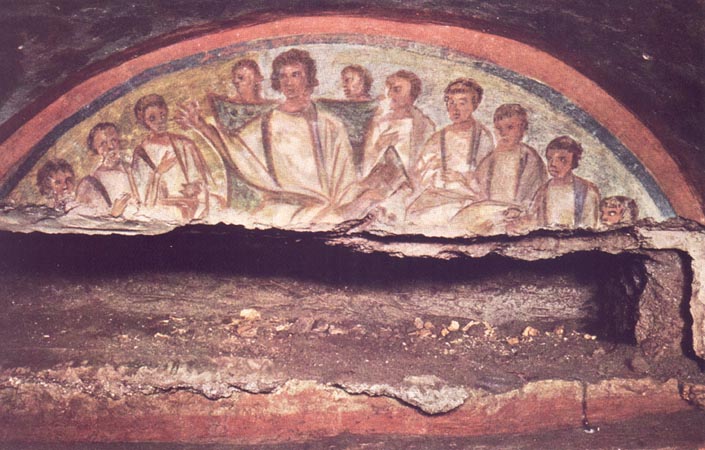
As Christianity spread, art forms changed from displaying humanistic pictures to more spiritual ones. Statues displaying religious aspects were not allowed, but relief sculptures and painting were fine. The artists of this time came from diverse cultural and religious backgrounds, so early Christian art style was completely new and combined of many different styles. Traditional Roman symbolism and pagan symbols were found in early Christian art. Modeling after the Romans, Christians began burying the dead in catacombs and decorating them. A common art form was the fresco, quickly painted and blended brushstrokes on top of another, giving it an impressionist rather than realistic look. On sarcophagi Christian sculptures carved historical and mythological scenes, portraits, animals, and nature motifs. The mix of Roman symbols and Biblical scenes such as Daniel and the Lion and Jonah and the Whale were also common. Unlike Christian art known today, early Christian art did not depict Jesus's crucifixion or the cross. Jesus was displayed as allegorical figures. Early Christian art was realistic and detailed, but size and position was distorted to show status. Since the cross could not be blatantly displayed, symbols of hidden crosses were common. After the Edict of Milan, Jesus, the cross, and other Christian symbols were clearly displayed in the form of colorful mosaics. 

Friday, September 26, 2014

BBC Confucianism Podcast

Confucianism 

Confucianism, a philosophy that originated in China during the Era of Warring States, was created by Kung Fu Tzu. He came from a class of scholars who based their teachings on their ideas; he and his disciples traveled around China spreading his ideas, which were not extraordinary at the time due to it being one of many ideas created by scholars. Confucius emphasized human interaction and a human society, and he claimed that he was a reformist of ideas from the Zhou Dynasty. Contrary to the supernatural beliefs of the previous dynasty, Confucius believed in a philosophy about people and how one treats another. His central ideas were to respect the social hierarchy, rituals, and parents. His ideas were a reiteration of what people knew, but since the political and social system had broken down during the Era of Warring States, he wanted China to return to its original state. He believed the key to good government was education, which was against the idea of sheer efficiency of that time. Once China became unified, the solution of keeping the empire unified was for the elite to be brought up by a standard education, which was the idea of Confucianism. Confucianism became more popular than the many other philosophical ideas of the time because of the work of Confucius's disciples. A strong bureaucracy, which was run by Confucians, sprung up because of Confucius's educational ideas that formed the examination system.

Tuesday, September 23, 2014

Major Religions of the Ancient World

Judaism

The history of Judaism begins during the Bronze age in the Middle East; it was a monotheistic religion, so the Jewish people worshiped God and Abraham. They worshiped in the Temple during early times, but later, rabbis encouraged Jews to observe ethical laws and cycle of prayer at home and at synagogues, which decreased the importance of the Temple. During the rule of the Romans, the Jews rebelled against them, but were brutally put down. The Temple was destroyed, marking the end of Temple worship in Judaism. A second revolt left many dead, enslaved, and banned from Jerusalem. Jews were persecuted and sent to exile in Babylon, which marked the beginning of Diaspora (living away from Israel). Despite Roman oppression, Judaism expanded and scholars created the first written collection of rabbi teachings, later compiling into the Talmud. The second and better version of the Talmud was finalized in 400 CE, around the time when Jews were granted Roman citizenship, but forbidden to marry Christians. However, later in 439 CE, Romans banned synagogue building and prohibited Jews from holding offices.

Zoroastrianism

Zoroastrianism, originating in Persia, is one of the oldest monotheistic religions and later, affected Judaism. 549 BCE, The Archaemenian Persians created the Persian Empire and made Zoroastrianism the official religion of the empire. The kings ruled justly in accordance to Zoroastrian law of truth and righteousness. Cyrus, the first Archaemenian Persian king, was religiously tolerant toward exiled Jews, which would eventually lead to Zoroastrianism impacting Judaism. When Greek leader Alexander the Great defeated and conquered the Persian Empire, Zoroastrianism felt a huge blow. Its priests and texts were destroyed, but the core of the religion, recorded in the Gathas, survived. After Alexander's empire split, the Seleucids ruled Iran, and Zoroastrianism became autonomous. The Parthians overthrew the Seleucids and recollected Zoroastian texts. Using Zoroastrian as propoganda, the Sasanians usurped the Parthian throne. Under the Sasanians, one Zoroastrian church was created under the control of Persia. The Gathas texts were preserved, use of images in worship was banned, fire temples were promoted, and religious tolerance was no longer practiced during this time. 

Christianity

Christianity, a strain of Judaism, began with the emergence of Jesus, a Jewish teacher in Israel. He distanced himself from the Jewish community and began preaching his beliefs on his own and eventually attracted enough followers for Jewish officials to see him as a threat. Christians believed that Jesus was God's son, which the Jews did not. After his persecution and death by the Jews, his twelve apostles further spread his teachings. Christianity would have not made a lasting impact if Paul did not help spread it. He was first in opposition to Christianity, but converted after he was temporarily blinded. His teachings were centered on the death and resurrection of Jesus; he built Christian churches throughout the Roman Empire. The Romans persecuted Christians no differently than the Jews. However, the persecution ended when Constantine became the Roman emperor and converted to Christianity after winning a battle to become emperor. Christianity then became the official religion of the Roman Empire. When the Roman Empire collapsed, Christianity split into a Western and Eastern strain: the Orthodox church the Roman Catholic church.

Buddhism

Buddhism was founded by Siddhartha Gautama through his path to Enlightenment to end suffering in the world. He was a prince, but abandoned his royal status after seeing all the pain and suffering in life. He became a monk first, but realized asceticism did not offer a solution to suffering no more than luxury. He found the Middle Way and finally achieved Enlightenment, along with the creation of the Four Noble Truths. He devoted the rest of his life to teaching and spreading his beliefs. After the death of the Buddha, Buddhism diverted into two strains: Theravada Buddhism and Mahayana Buddhism. The Theravada strain follows the original beliefs of the Buddha of stressing the importance on the individual and dismissing the importance of gods and goddesses. Theravada Buddhism remains popular in Sri Lanka, Cambodia, Thailand, Laos, and Myanmar. Mahayana Buddhism incorporated religion-like elements into Buddhism such as worshiping the Buddha as a god and setting up Buddhist shrines and temples. This strain became more popular than the Theravada strain and flourished in Tibet, China, Taiwan, Japan, Korea, and Mongolia.

Hinduism

The origin of Hinduism is not defined since it embraces the traditions of Vedic culture and Buddhism. Hinduism existed as early as the early BCEs but became strengthened in the Classical Age. Hinduism follows the Vedic concepts of karma and reincarnation. The idea of dharma is central to Hinduism. There are thousands of Hindu gods since most of them are reincarnations of the Buddha. The rise of the Gupta empire in 300 CE gave rise to the great gods Vishnu and Shiva. From the Gupta empire and on, Buddhism faded out of India and its beliefs merged with Hinduism, which became popular in India.  

Thursday, September 18, 2014

Buddhism and Its Spread Along the Silk Road Summary


Birth of Buddha and the Development of Buddhism in India and Central Asia

The Buddha was originally a wealthy prince who lived by his family name of Gotama in northern India. Early in his life, however, he abandoned the luxuries of royal life and left home to found enlightenment. After seeing people suffer and die, he came up with the idea of the Four Noble Truths and found enlightenment. He devoted his life to spreading his teachings. When he died, he was a famous figure in India; his body was divided among eight clans and each build a memorial stupa for his body. His followers formed councils, a major one being in Pataliputra of the Mauryan Empire. The Mauryan King, Ashoka, converted to Buddhism after seeing a particularly bloody battle. He rigorously worked to spread Buddhism in his empire. He engraved edicts of the Buddha's teachings, celebrated the stupa rituals, and imprinted the Sarnath lion on India's curreny and flag. His support of Buddhism led monks into Hellenized regions of Jushan and Bactrian in the west. The Kushans controlled trade between India, China, Parthia, and the Roman Empire, which made it an ideal location for the spread of Buddhism. Under the Kushan king, the Graeco-Buddhist art form was created and affected the arts in Central Asia. Buddhism further penetrated the Parthians and Sassanians. When Bactria and Kushan became Buddhist centers, they expanded into Hadda, Bamiyan, and Kondukistan, which formed one of the greatest Buddhist monastery community in Central Asia. By 600 CE, kingdoms of the Tarim Basin were completely Buddhist, and Sanskrit had become the religious language. 

Buddhism in the Steppes and China

Buddhism penetrated the Xiongnu, a confederacy of nomads in the steppes of China. Their worship was evident in their offering of a Buddhist statue after losing to the Hans. Buddhism had a strong effect on the lives of nomads; once they adopted Buddhism, they were no longer barbaric or aggressive as before. This weakened the military strength and independence of the nomads, and they eventually assimilated with civilized empires. An example of these events happened to the Tobhatch Turkish nomads. They had adopted Buddhism faith early in history, and over time, their capital moved closer to the Turkics until the nomads and the Turkic people assimilated. The Mongols during their control of the Silk Road preferred Buddhism over Islam. Buddhism reached China when the Silk Road trade began. After that, Buddhism spread, catalyzed by Han emperor Mingdi's dream and curiosity about the Buddhism. After that, the belief in the Buddha, Buddhist scriptures, and Buddhist monks were brought to China. Buddhism reached its height during the Sui and Tang dynasties. 

Decline of Buddhism and Buddhist Art

After reaching its height in the Sui and Tang dynasties in China, it began to decline, starting from a series of persecution of Buddhists The collapse of the Tang Dynasty allowed Arabs to invade and convert their lands to Islam. They destroyed Buddhist statues, paintings, temples, and stupas, ending Buddhism in Central Asia. Though Buddhism declined along the Silk Road, its impact on art was profound. The contact of Hellenized art and Buddhism created a new art form. Before Buddhism reached Hellenized Gandhara, there were no statues or pictures of the Buddha. Greeks who used their classical art knowledge shaped Indian art and formed the Greek-featured Buddha. The rise of Buddhism allowed monasteries and stupas to be built. Cave painting was also a unique feature in Buddhist architecture. The cave art tells about the lives and cultures of the ancient people. 

Questions

1. What was the impact of Buddhist beliefs on nomads in the steppes?
Buddhism weakened the nomads' toughness and soldierly qualities, which made them lose their nomadic identity and allowed them to become assimilated into civilized empires.
2. What was Kumarajiva's role in spreading Buddhism in China?
Kumarajiva organized the first translation bureau, and he and his partners translated Buddhist scriptures into Chinese.
3. How did Buddhist art change in the 200sCE?
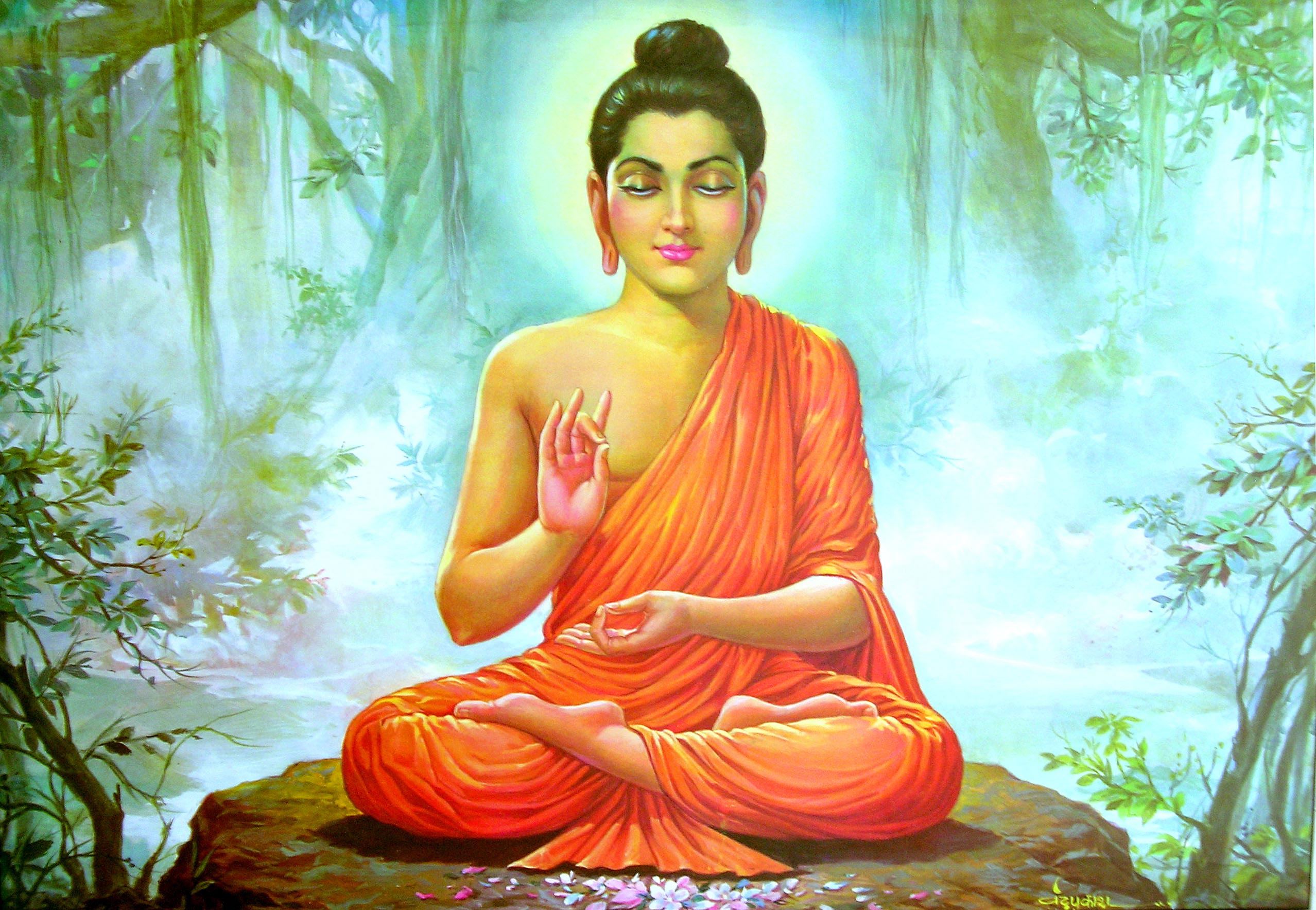
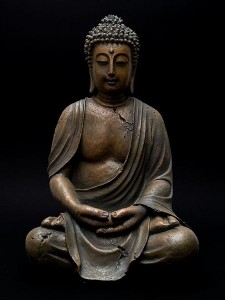
Greeks created the first images of the Buddha by combining their classical art sense and Indian styled art. The Buddha was dressed in a toga and sat in a yoga pose, which represents both Greek and Indian culture. 
4. What caused Buddhism along the Silk Road to decline?
The collapse of the Tang dynasty in China allowed Islamic invaders to conquer Buddhist lands and convert them to Islam. 

Friday, September 12, 2014

Tour of Classic Rome Review

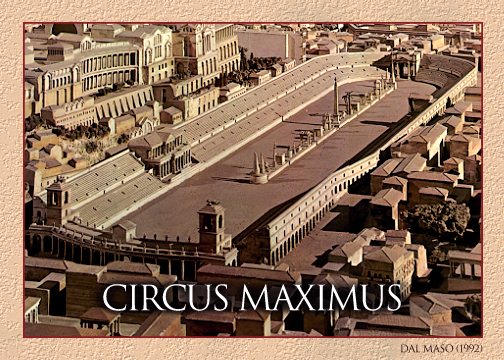
Rome under Emperor Constantine was divided in two by the Tiber River. Rome had seven major hills; the Temple of Jupiter was on the Capitoline Hill and served as the main temple and center of religious cults of Rome. The Palatine Hill, another major hill, was where the ruler lived in his palaces. Past the Circus Maximus, an enormous chariot racing stadium, lay the wondrous Imperial Palace, where the emperor and his family lived as the central government. The Circus held many chariot races, animal hunts, parades, and religious processions. The emperor was a big supported of the games in the Circus and could go in his Imperial Box to watch them. In the city there was the Aqua Claudia, which was a large aqueduct that supported the large Roman population by carrying water to the city through gravity. Other sites include the Septizodium, the Arch of Constantine, the Meta Sudans, and the Baths of Trajan, which was a great public bath. These structures show the Roman's phenomenal engineering skills. The Baths of Trajan was several bathing building enclosed in a garden-like courtyard and a wall.


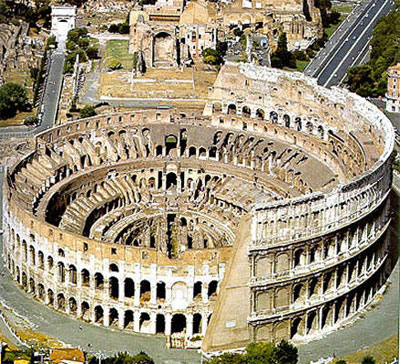
The Colosseum, a famous building in ancient Rome, was an oval amphitheater where civilians could watch gladiatorial combats, creative executions of criminals, and hunts of wild animals. The front seats were reserved for the emperor and his family, high officials, and priests. Behind them were the senators, wealthy businessmen, and free, land-owning citizens. The very top seats were for women, slaves, and foreigners who were considered unimportant and low class. The Temple of Venus and Rome was actually two temples back to back, one part for worshiping Venus and the other part for the goddess Roma. Venus faces the Colosseum while the Roma faces the forum. The Basilica of Maxentius was a big civil building used for courts. The Roman Forum had a big, open public space used for public events like parades and speeches. The buildings around the open space were courthouses and temples. On the Forum plaza, there were monuments revering great men and leaders of Roman history.  The Pantheon, a building with eight columns at its front like a temple, surprisingly had a rotunda ceiling. The columns were enormous and must have required so much stone and manpower to build. The Pantheon was used to celebrate and worship the Roman emperors; it had statues of Julius Caesar and Augustus.

Thursday, September 4, 2014

Alexander the Great

Summary of "Alexander the not so Great: History through Persian eyes", written by Ali Ansari


Alexander the Great is known as one of the greatest military geniuses in history because he conquered the Persian Empire and established his own empire that would become the largest in ancient history. Greeks view his conquest as a good thing, bringing civilized culture to the "barbaric East". However, many people do not see the other side of Alexander the Great through another perspective: he burned Persian city Persepolis to the ground and destroyed temples and priests of the Persian religion Zoroastrianism.

Though Alexander the Great conquered the Persians out of revenge for their past ruler Xerxes's invasion of Greece, the Persian Empire was the greatest the world had yet seen and obtaining it was the holy grail of prizes. In fact, the Greeks greatly admired Persian kings for their ability to strike both terror and admiration in the hearts of men throughout such a vast empire. 

The Persians and the Greeks were interconnected in many ways: some Greeks fled to Persia and lived better than they did in Greece, while Persians aided victory to the Spartans in the Peloponnesian War. Persian prince Cyrus the Younger developed a good relationship with the Greeks and recruited ten thousand Greek mercenaries who graciously praised Cyrus for being truly worthy of ruling a successful empire. 

Then came Alexander the Great, whom the Persians viewed as reckless youth. Alexander tried to embrace Persian way of life and immediately regretted his destruction of Persepolis. Like many future conquerors, Alexander the Great became seduced and attracted to the wonders of Persia.


1. What is the basic Western perception of Alexander the Great?  
Westerners see Alexander the Great as the mighty conqueror of Persia and one of the greatest military geniuses in history.
2. Why did he destroy Persepolis?           
He burned Persepolis in revenge for Persian ruler Xerxes burning down Greek city Acropolis.
3. What is the "Greek version" of Alexander's conquest of Persia? 
Greeks viewed Alexander's invasion as the first of many Western crusades to civilize the barbaric East.
4. What was Persia's actual standing in the world like?       
Persia was pretty civilized already because it was the greatest empire the world had seen, extending from Central Asia to Libya. It was a rich prize to anyone who wanted to conquer it.
5. How did the Persians gain advantage in the Peloponnesian War?
Persian rulers achieved their goals by turning the Greek city states against each other, ultimately causing the Peloponnesian War between the Athenians and the Spartans. Persia aided the Spartans by supplying them naval equipment.
6. How do the Persians portray Alexander? 
Persians view Alexander the Great as a destroy and a reckless youth.